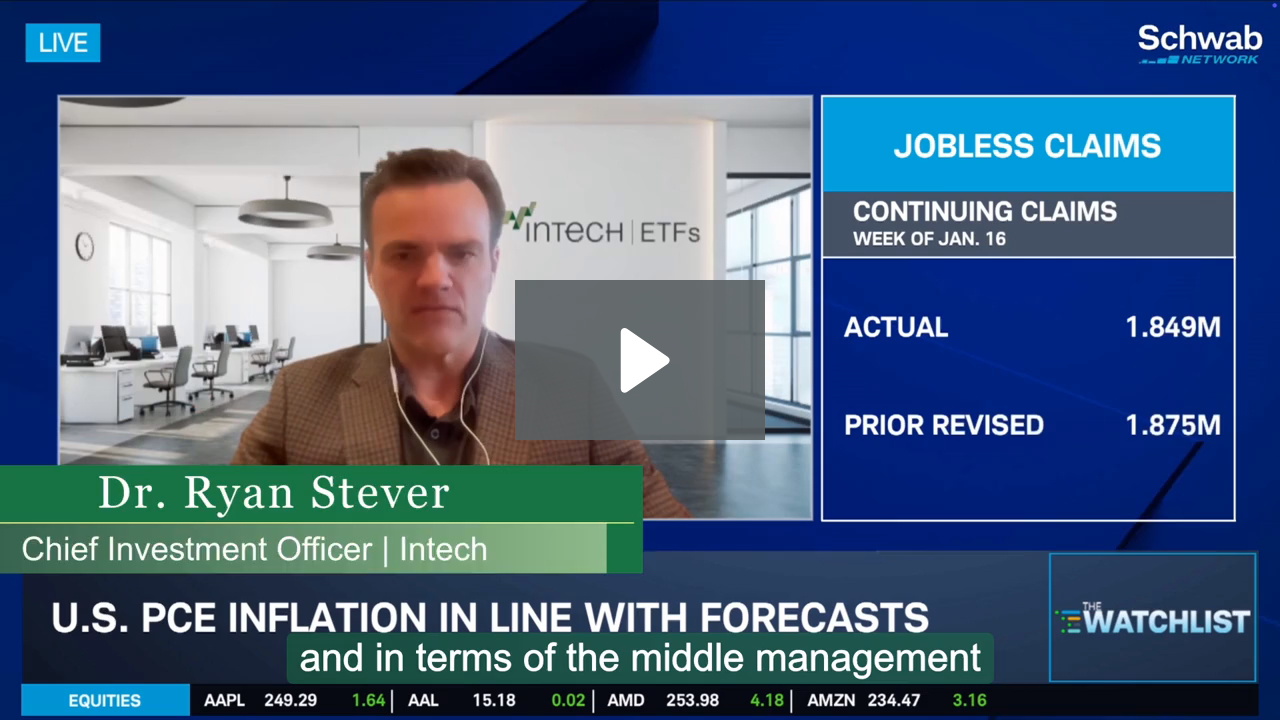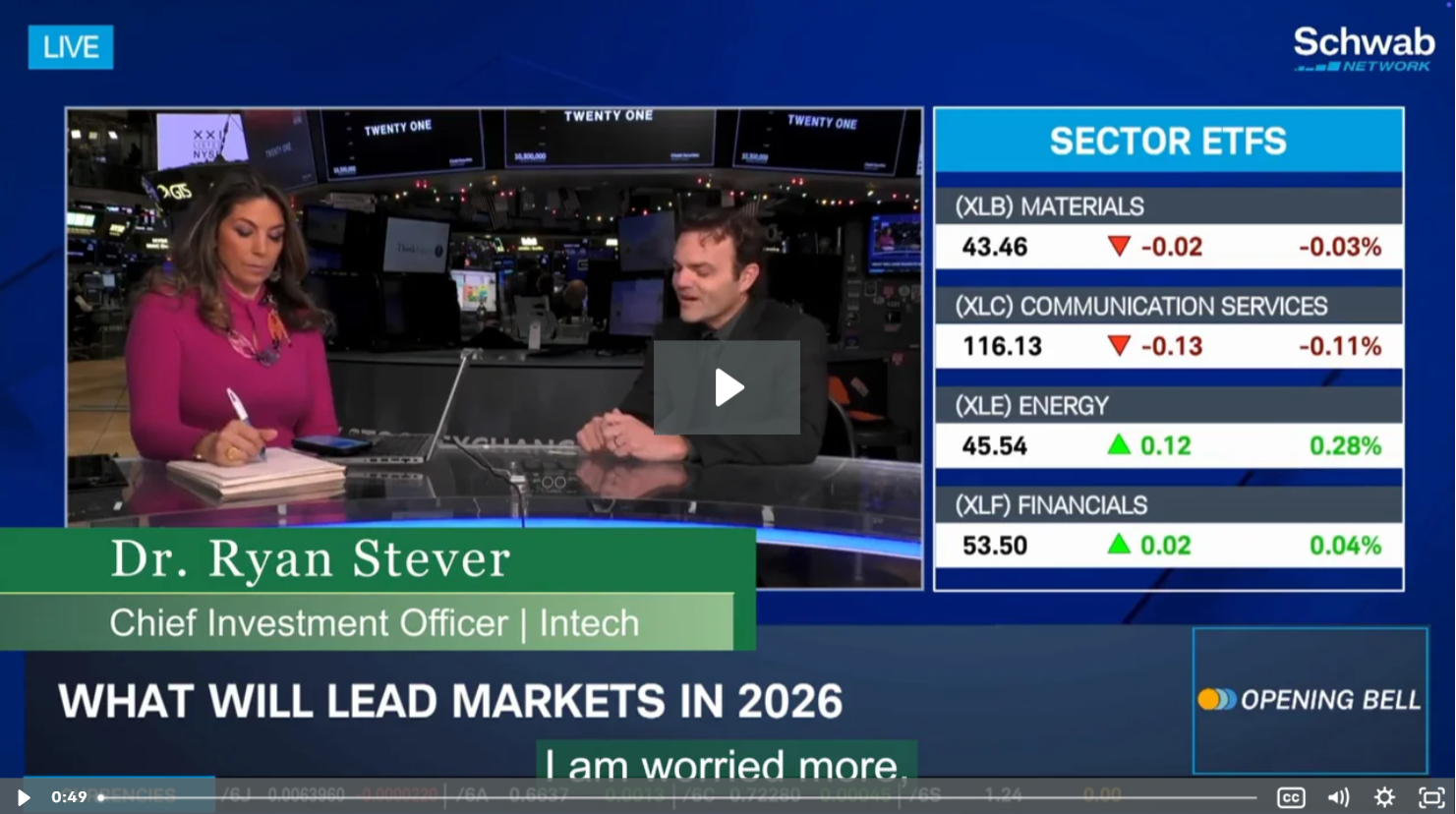
This interview aired on April 7, 2026, during a period of elevated volatility and rising oil prices. Since then, markets have rebounded as ceasefire developments helped ease immediate energy pressure and improve risk sentiment. The interview should be read in that live market context, while its broader points on concentration, diversification, and portfolio structure remain relevant.
Markets can look broad on the surface and still be narrow underneath.
That is the thread running through Ryan Stever’s latest Schwab Network interview. The conversation began with volatility and macro pressure, but it quickly moved to the issue that matters more for long-term portfolio construction: how risk is actually distributed inside today’s market. That issue is central to Intech’s own current view of core equity. Intech’s concentration work describes today’s beta exposure as “efficient on cost, inefficient on risk,” noting that market leadership remains narrow and that risks can build inside holdings that still look diversified on paper.
Volatility Can Reveal More Than Headlines Do
Ryan’s starting point was that the market had gone through a long stretch of exuberance. His point was not simply that volatility had returned. It was that the cross-section had opened up, and that mattered.
“When I look back at the market, there was a lot of exuberance, if you will, really running from July to January… there was a huge sentiment-driven market… and as we were seeing the dust settle, I do think there’s companies out there with attractive prices now.”
He followed that with a useful observation: “There was a lot of huge cross-sectional moves,” and that may have left “good prices really across the market.” That is a different way to think about volatility. Instead of treating it only as noise or discomfort, it treats volatility as a sorting mechanism. Prices move apart. Relative value may reappear. Opportunity becomes less uniform and more selective.
That view also fits Intech’s broader process language. Intech’s research describes more favorable conditions as periods with broad stock-level dispersion, rotating leadership, and differentiated correlations across stocks, because those environments may create more room for diversification and rebalancing to add value. At the same time, those materials are careful that outcomes vary by market environment and are tendencies, not guarantees.
AI Still Matters. So Does the Gap Between Theme and Payoff.
Ryan was clear that AI remains one of the market’s defining forces. He did not argue with the theme. He questioned how cleanly the market can already price its eventual payoff.
“…the difficulty… is, okay, how much cash will it [AI] generate eventually? How will the big players manage to translate what they’re doing into cash for themselves?”
That framing is important because it separates belief in the theme from certainty around the economics. AI may remain one of the market’s central drivers for years. But the market still has to decide how much future benefit belongs in present prices, how concentrated that exposure has become, and how much disappointment can be absorbed if monetization takes longer than investors expect.
Ryan also described oil as a “sobering up moment” before markets could fully focus on the benefits of AI. That point fits the sequence that followed the interview: oil pressure eased as ceasefire headlines improved sentiment, helping equities rebound, but the market’s selectivity did not disappear. Schwab’s own post-interview market coverage described a measured recovery with volatility fading, energy stabilizing, and sector-level dispersion still very much in place.
Concentration Beneath the Surface
The sharpest part of the interview came when Ryan turned to large caps.
“The market is concentrated. If you’re buying the S&P 500, your risk budget is taken up by a dozen names, less, half a dozen.”
That is the clearest statement in the interview, and it matches the core problem Intech has been emphasizing elsewhere. Intech’s recent blog post argues that cap-weighted benchmarks may no longer function as neutral policy anchors because concentration, characteristic drift, and narrow leadership can embed material, measurable risks inside passive allocations.
Ryan’s point is practical. A portfolio can own “the market” and still behave as if it is leaning on a very small group of stocks. That is what makes the issue structural rather than simply tactical. It is not just about whether the biggest names go up or down in a given week. It is about whether broad exposure has quietly become narrow risk.
He also made an important distinction: the answer is not simply to slash exposure to the largest names. Doing that can quickly create large tracking differences, and then the conversation shifts from diversification to benchmark deviation. That is why he describes the better answer as “very structured diversity.” That idea is consistent with Intech’s benchmark-aware portfolio design language: examine volatility and fundamental signals, optimize to balance return and risk contributions, and rebalance to renew diversification while respecting constraints.
What This May Mean for Portfolio Construction
Ryan closed by widening the conversation beyond large caps. His point was not that mega-cap leadership must end immediately. It was that investors may not want to leave themselves dependent on one dominant assumption about how growth and scale will keep showing up in the market.
“The SMID-cap diversifies in a number of ways… we see a lot of opportunity for stock selection… The last point I’d make in terms of diversification is… the market has [historically] rewarded scale… I think you want to diversify that bet.”
That is a measured conclusion, and it works because it avoids making a dramatic style call. Small- and mid-cap exposure is presented here as a way to broaden the opportunity set, diversify away from dependence on a handful of dominant businesses, and participate in a part of the market where dispersion and selection may matter more. Intech’s own materials position SMID exposure similarly: benchmark-aligned, quantitative, and designed to fit into broader model portfolios without gaps or overlap.
The larger message is straightforward. Volatility may fade. Oil may cool. The market may snap back, as it did after the interview. But those shifts do not resolve the concentration issue on their own. They simply make it easier to overlook again. That is why the interview remains timely. It is less about predicting the next market move than about asking a better portfolio question: not just what the benchmark owns, but how much of the portfolio’s risk is actually coming from a very small number of names.
That is where structure matters.