
For decades, investors have been taught:
Volatility equals risk.
Risk should be minimized.
That framing is incomplete.
Volatility is movement.
Risk is impairment.
They are related — but not identical.
In core equity, volatility is unavoidable. The question is not whether it exists. The question is whether portfolio design treats it as noise to suppress, or structure to engage.
The Hidden Cost of Suppression
When volatility is treated purely as something to dampen, portfolios often drift toward what appears stable:
- The largest companies
- The most crowded trades
- The recent winners
Over time, that instinct can increase concentration. Leadership narrows. Risk contributions skew. Diversification erodes quietly.
This is not a behavioral error. It is structural.
Price movement reshapes portfolios automatically.
Winners grow larger.
Laggards shrink.
Risk redistributes (without a vote).
If nothing intervenes, volatility compounds into concentration.
That is not theory. It is arithmetic.
Dispersion Is the Raw Material
Markets do not move uniformly. Stocks diverge.
Some rally while others stall.
Some rotate with sector cycles.
Correlations expand and contract.
This divergence, dispersion, is not a flaw in the market. It is a defining feature.
If every stock moved identically, diversification would be irrelevant.
But because stocks move differently, portfolio structure matters.
When two stocks with similar long-term growth follow different paths, a static allocation allows the winner to dominate exposure. A structured allocation can reset balance.
That reset potentially does two things:
- Restores diversification.
- Converts dispersion into incremental trading profit, subject to costs and market conditions.
Volatility, in that sense, is potential energy.
Interaction Is the Missing Dimension
Most investment frameworks focus on what to own:
- Valuation
- Quality
- Momentum
- Size
Those characteristics influence expected returns at the company level.
But a strategy’s outcomes are also shaped by interaction; how holdings move relative to one another over time.
When correlations are imperfect and dispersion is present, structure becomes an active force.
Without interaction management, volatility builds drift.
With interaction management, volatility can become structural input.
That distinction separates inclusion from design.
Rebalancing: More Than Risk Management
Rebalancing is often described as maintenance.
It is that — but it is more.
When positions are refreshed within defined constraints, two things occur:
- Risk concentration is managed.
- Divergence between holdings is systematically engaged.
Trimming relative winners and replenishing relative laggards does not rely on predicting the next leader. It relies on the existence of dispersion.
If dispersion is broad and leadership rotates, the rebalancing discipline potentially contributes excess return over time. If leadership remains narrow and persistent, or dispersion compresses relative to costs, the opportunity may diminish.
Rebalancing is not a guarantee.
It is a structural response.
Without it, volatility compounds into unintended risk.
With it, volatility becomes both governance tool and potential return contributor.
Environment Matters
Volatility effects are not constant.
More supportive environments tend to include:
- Broad stock-level dispersion
- Rotating sector or style leadership
- Differentiated correlations
Less supportive environments may include:
- Narrow, persistent leadership
- Compressed correlations
- Low dispersion relative to transaction costs
This variability does not invalidate the framework. It defines its conditions.
The objective is not to time regimes.
It is to apply a standing structure that operates across them.
The Real Reframing
Core equity is not designed to eliminate volatility. It is designed to deliver market exposure within defined risk guardrails. The goal is not downside protection. It is not guaranteed outperformance.
It is a systematic way to take equity risk, integrating fundamentals with portfolio structure across evolving markets.
Volatility is not an anomaly in that system.
It is the mechanism through which leadership changes, correlations shift, and dispersion emerges.
The fiduciary question is not:
How do we suppress volatility?
It is:
How do we govern it?
A structure-first framework does not rely on forecasting volatility’s direction. It incorporates it, maintaining benchmark alignment while refreshing diversification through time.
Volatility is uncomfortable.
But in a disciplined portfolio, it is not the enemy.
It is the mechanism.
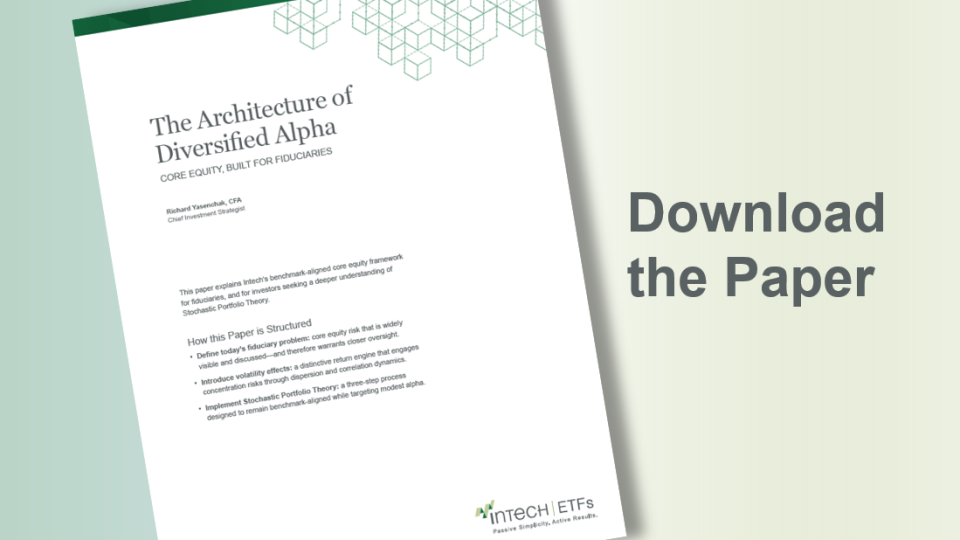
Explore the Full Framework
See how disciplined portfolio structure integrates volatility and fundamentals within benchmark-aware guardrails.
Learn More → Intech | The Architecture of Diversified Alpha